
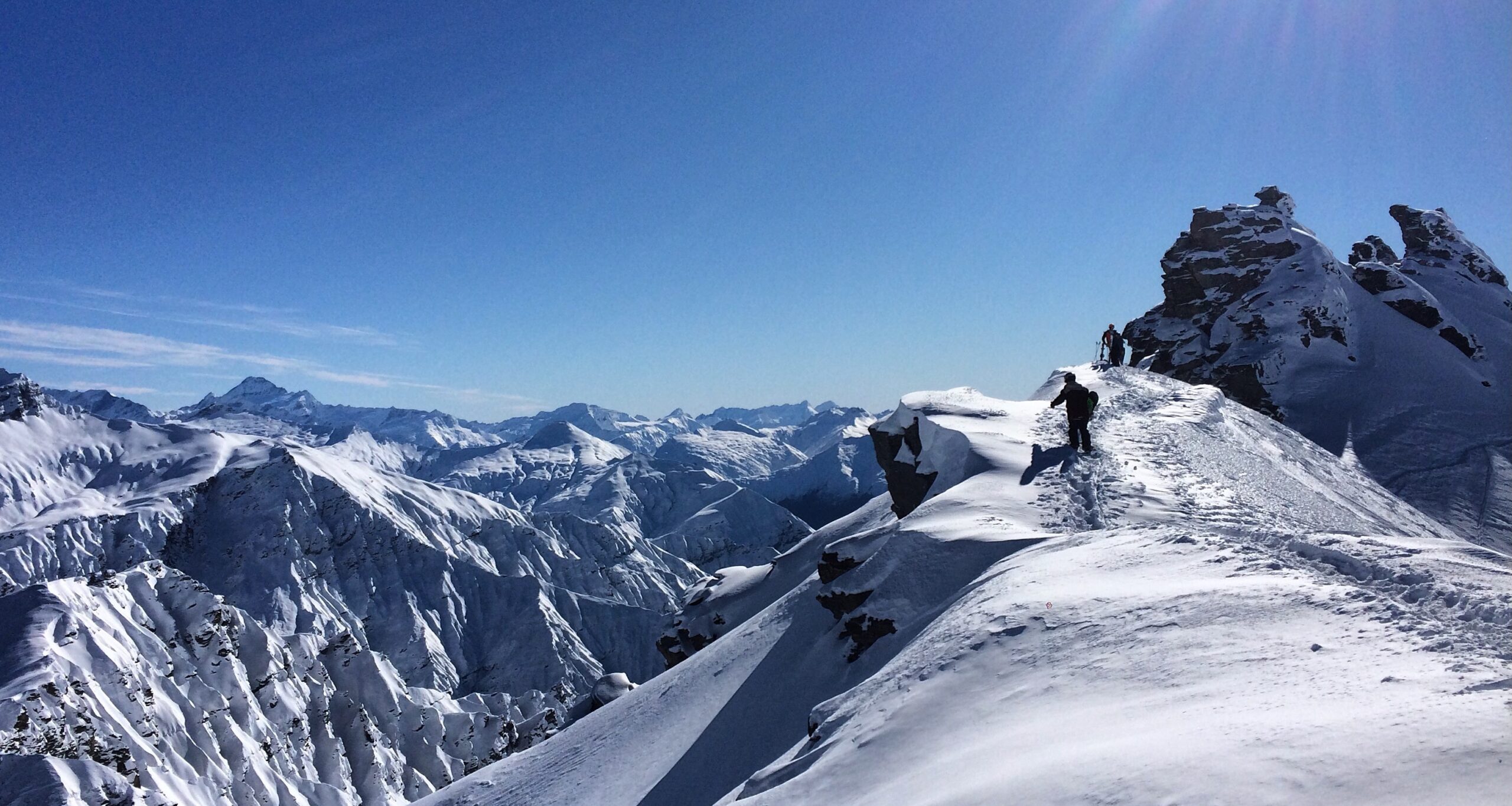
Tyler recently sent me an article by Michael Suter about how economists and scientists see the world differently. This might seem obvious (particularly for anyone who’s ever met an economist. Or a scientist for that matter). And, according to Suter, it has profound implications for tackling policy issues: “you can’t agree on the route if you don’t agree on the map”.
This article was written in the context of climate and environmental change. According to the research, the issues that researchers rated as most important were informed by the solutions they were used to working with, rather than the other way around. Economists, with their predominantly market-based training, were more likely to place weight on solutions with theoretically market-based solutions, like climate change or air pollution. More complex, systemic issues like biodiversity loss came up far more often for environmental scientists. Scientists were also more pessimistic than economists about our capacity to solve these issues.
Several reports recently have described how economic models are failing to capture some of the scariest potential impacts of climate change (including Stern and Stiglitz, 2023, 2021, IFOA, 2026 and Carbon Tracker, 2026). Tipping points and catastrophic damages, with their pesky non-marginal implications, really don’t fit well into most economic models. This is not, of course, an excuse for ignoring them. But it seems that most economists have judged their likelihood sufficiently low to justify excluding them from models. Any economist will tell you that models are huge simplifications of the world. No one can predict a population of nine billion people with equations. But the simplifications which make economic models solvable are looking less acceptable.
So what do scientists think? Scientists are exceptional at understanding and modelling phenomena in the physical world. The level at which we can model the global climate is mind-blowing. As a result, they have modelled, forecast, and tracked the merciless rise of greenhouse gas concentrations and temperatures, along with other environmental pressures. Scientists’ warnings of tipping points and nature collapse have become increasingly difficult to ignore. Even for economists.
I work and trained as an economist. But I also have a physics degree. I can’t say my quantum mechanics (or even regular old mechanics) has stood the test of time. But I do remember some of the principles of a science education, and I think they’ve served me in my career.
My first PhD project was to try to incorporate catastrophic damages into a simple economic model. Tricky stuff – I didn’t pull it off, but the concepts filtered through to the rest of my studies. The foundational question of my PhD basically became: what is the fastest route out of this mess?
There is much to be said about economists’ focus on solutions and policies. But if it comes at the cost of ignoring the toughest, gnarliest parts of the problem, as Suter’s research suggests, then these solutions are incomplete. Similarly, scientific models that don’t elicit practical solutions have only limited use.
I wonder whether all economists should be made to take a science course or two at university, and vice versa. It might help us land on the same map.
At my university we were required to take ‘general education’ classes outside our main department. I took a theology class, which was certainly different from physics and economics, and very interesting for someone with little exposure to religion. Pascal’s Wager is a theological concept about whether we should act in line with God’s wishes. The potential loss for displeasing God is eternal punishment in Hell – or in economic speak, infinite disutility. So if we think there is even the tiniest sliver of a chance that God and Hell exist, Pascal argues (and utility maximising economists would be forced to agree) that the only rational option is to act as if they do.
Pascal’s Wager has a parallel in policy as the precautionary principle. This is not the approach we are currently taking to climate change, even as scientists serve up increasingly scary headlines. Figuring out how to better integrate the science of catastrophic climate and nature change into mainstream models of the economy should be a key priority for economists and policymakers. Some models already do this (see Howard and Sterner’s 2025 meta analysis), but not enough. Before we can start arguing about solutions, we need to agree on the map.


Leave a Reply to Sheryl French Cancel reply