

Last week I presented at UK Finance, under the brief ‘why should the finance sector care about climate change?’. For most non-sustainability finance professionals, the answer to this question isn’t necessarily obvious. Nonetheless, there are lots of reasons finance should care about climate and I’ve written about them before (in a blog post and in BusinessGreen). This post isn’t about that though. It’s about the links between capitalism and climate change. Capitalism, arguably a driver behind climate change, is increasingly replacing policy as the driver behind climate action. This is good news for resilience but bad news for fairness. Policy needs to step in.
Much of the questions were along the lines of ‘do you think the net zero transition will continue despite the ESG backlash?’ or ‘how do you maintain optimism when politics is so divided?’. As I’ve written about, maintaining optimism in climate progress isn’t always easy for me, nor for many of my friends and colleagues. But my answer to these questions at UK Finance, and my own worries, is that the economics of the transition has changed in such a way that this is no longer just a question of politics, but also of capitalism.
Carbon-free energy, a cornerstone of the net zero transition, is getting cheaper. The cost of solar panels has fallen precipitously. Other renewable energy costs are falling as well, with onshore wind now the cheapest source of electricity per kilowatt-hour. Demand-side technologies are becoming more competitive too. Last week in the UK new electric vehicles reached price parity with their fossil-fuelled cousins. All this means that the business case for decarbonisation is getting stronger. There is obviously continued uncertainty and market conditions vary. But investment trends are on the rise, and relatively impervious to politics. For example, if Texas – a resolutely red state – were instead country, it would rank fourth in the world for installed wind capacity. Solar is expected to make up the largest share of its new generation capacity in 2026.
The Iran War is making the case for renewables even stronger. Energy independence is one thing – there is much to be said for not relying on the Strait of Hormuz to boil your kettle! But it’s not just about independence. The US is a net energy exporter, meaning it produces more energy than it consumes. The import balance varies by fuel, but in 2024 the US sold more petrol, natural gas, and coal than it bought. But fossil fuels are commodities, and therefore priced on international markets. So even in the energy ‘independent’ US, consumers are feeling the pinch. Average petrol prices have increased 36% since February. Real energy independence is one which divorces national energy markets from international commodity markets. Only electrification, supplied by renewable and nuclear generation, can deliver this.
I took a class on Rethinking Capitalism earlier this year at UCL’s Institute for Innovation and Public Purpose. It was really interesting, particularly for someone largely trained in orthodox economics, which – if, like me, you didn’t know – was essentially invented to explain humans’ economic behaviour under capitalism. I’m embarrassed to admit this, but this was the first time in my academic training that I questioned the implicit assumption that we are motivated by our own self-interests. This axiom that underpins essentially all mainstream economic theory. Even more left-field disciplines, like behavioural economics, rely on this assumption – they just account for the fact that sometimes humans are truly terrible at judging what is good for us.
Capitalism is broadly defined as an economic system in which actors seek to accumulate capital – or profits – from labour. Capitalism’s rise, beginning around the 16th century, was tied to the commodification of land, the rise of international trade, and the development of finance. Its history is intertwined with colonialism and slavery. The exploitative nature of capitalism was one of the central tenets of the class.
In many ways, the evidence bears this out. Inequality has risen dramatically in recent decades, both within and between countries. The average person in North America earns 21 times the average person in Sub-Saharan Africa. Wealth is even more unequally distributed, even within the same country. In the US, the share of wealth held by the top 1% increased from 23% to a staggering 32% since 1990. Yet it is equally undeniable that the dominance of capitalism also coincided with the swiftest rise in living conditions. We can’t dismiss capitalism without acknowledging the progress it has facilitated.
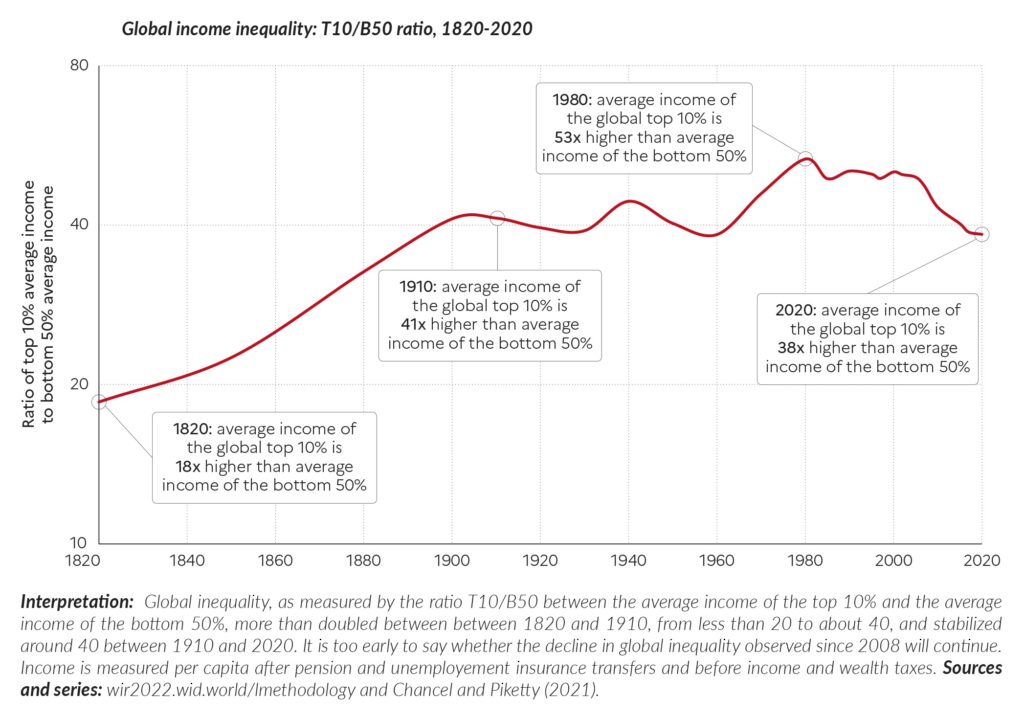
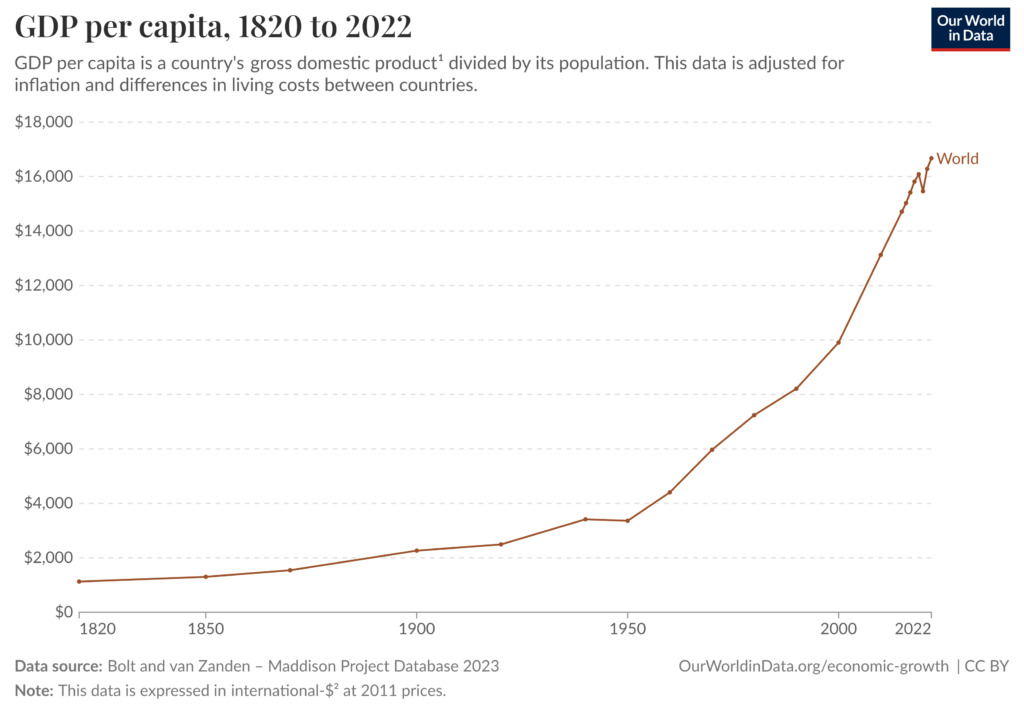
That doesn’t mean that modern capitalism is fit for purpose. The second half of Rethinking Capitalism considered the main challenges facing modern societies and their links to capitalism. We discussed labour insecurity, artificial intelligence, financialisation, and climate change. All of these challenges have been precipitated or amplified by capitalist structures, and pose a real threat to living standards. The gaps between rich and poor, already huge, could worsen if they remain unaddressed. Much of the course was a call to action about how to, as you imagine, rethink capitalism.
The answer remains elusive. Admittedly the course didn’t promise answers (it’s not Capitalism Rethought), but still I was hoping for more concrete solutions. There was no lightbulb moment for me, partly because no complete, convincing, and proven alternative to capitalism exists. Perhaps the best option we have is to adjust the current system to meet our current needs in a way that better protects people and the planet.
One of these adjustments is Mariana Mazzucato’s mission economy. Inspired by the American moonshot effort in the 1960s, a mission-driven government would set a bold goal and dedicate the resources required to achieve it. Instead of tinkering around the edges to ‘fix’ market failures, Mazzucato says governments should become market-shapers. There are of course many constraints (fiscal balances, political consensus, risks of inflation). But the mission framing seeks to prod governments’ ambitions to address the defining challenges of this century.
What is the link between Rethinking Capitalism and my talk at UK Finance? Another good question with a less-than-obvious answer. But there is one: while I believe that the capitalist economics of net zero will continue to propel the transition, that doesn’t negate the benefits of a ‘climate mission’ in our economy. A mission-led approach to climate change might protect against some of the potential downsides of a transition driven by economics alone: further inequality, with damages borne by the least able to recover. In Mazzucato’s telling, a climate mission could deliver large-scale, cohesive technological and social change required to reach a net zero society, in time to avoid the worst impacts of climate change. The UK has taken this approach to an extent with its Clean Power 2030 target, although this mission focuses on non-consumer facing technology change that requires little social participation.
The concept of a climate mission relates to my PhD research. I studied the role of technology and climate change in net zero pathways. Based on historical examples, I found that technological transitions generally took longer than their social counterparts, when considering the time it takes to go from a scientific advance to a marketable product. Yet most pathways for the UK rely on technology to deliver emissions savings, largely discounting the disruptive market changes that will require (the Climate Change Committee increasingly considers demand-side measures, such as reduced meat-eating, a part of the UK’s net zero transition). One of the findings of my research was that policy, while not usually the instigator, can accelerate and entrench emerging social trends. A mission-led transition, as opposed to an economics-led one, could facilitate more of the types of demand-side policies that support a swifter, more equal net zero society.
Capitalism will continue to make its own argument for net zero, whatever policies – or politicians – are in place. Low-carbon technologies are increasingly the most economically appealing option. Becoming resilient to climate impacts and international energy markets is commercially sensible. And as climate change impacts become more apparent, these motivations will become more urgent. But capitalism can’t be left to drive the net zero transition alone. Mission-led climate policy could deliver a more fair, equal net zero economy.

Leave a Reply